
|9 min read|Joana Manjapane
How to Calculate Your Real Profit Margin in Ecommerce
ecommerce profit margincalculate profit marginreal margin online storeecommerce profitabilityhidden ecommerce costsnet margin online storeecommerce costs breakdown

Source: Unsplash
Gross margin vs. real margin: the difference that's costing you money
Gross margin only considers the product acquisition cost (or manufacturing cost). It's the formula most sellers use:GROSS MARGIN (the simplified version)
========================================
Selling price: $50.00
Product cost: -$25.00
--------
Gross profit: $25.00
Gross margin: 25 / 50 = 50.0%
Looks profitable. Right?The hidden costs devouring your margin
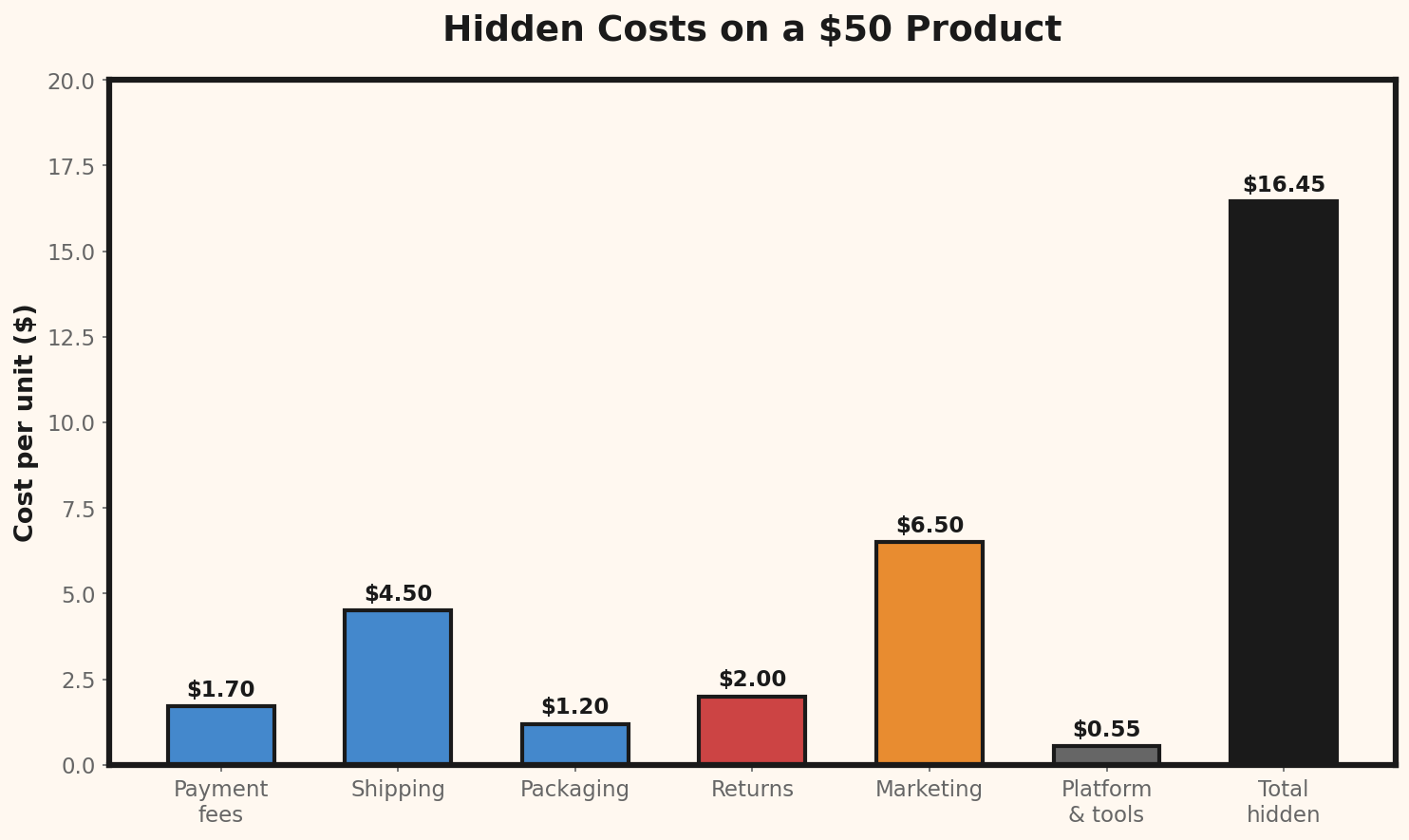
Here's a realistic breakdown of the costs most online sellers forget to include in their margin calculation. These percentages are averages from the ecommerce industry in 2025-2026:| Item | Typical cost | Applied to | Example ($50 product) |
|---|---|---|---|
| Payment processing fees (Stripe, PayPal) | 1.5% – 3.4% | Selling price | $0.75 – $1.70 |
| Shipping (if you offer free shipping) | $3.50 – $7.00 | Per order | $4.50 |
| Packaging (box, filler, tape, label) | $0.80 – $2.50 | Per order | $1.20 |
| Returns (average rate of 20-30% in fashion) | 3% – 8% of total revenue | Prorated per unit | $2.00 |
| Marketing / acquisition (Meta Ads, Google Ads) | 10% – 25% | Selling price | $6.50 |
| Platform (Shopify, WooCommerce hosting) | 1% – 3% | Monthly prorated | $0.80 |
| Software (email, analytics, tools) | 0.5% – 1.5% | Monthly prorated | $0.40 |
| Income tax | 15% – 25% | On net profit | Variable |
| Total hidden costs | ~$16.15 |

Source: Unsplash
Step by step: calculate your real profit margin
Let's do the complete calculation with a detailed example. Imagine you sell a premium phone case in your Shopify store:REAL MARGIN — Complete calculation
========================================
REVENUE
Selling price (retail): $50.00
DIRECT PRODUCT COSTS
Acquisition/manufacturing cost: -$25.00
TRANSACTION COSTS
Stripe fee (1.5% + $0.25): -$1.00
Shopify Payments fee: -$0.00
--------
Transaction subtotal: -$1.00
FULFILLMENT COSTS
Shipping (free for customer): -$4.50
Packaging (box + protection + sticker): -$1.20
--------
Fulfillment subtotal: -$5.70
MARKETING COSTS (prorated per unit sold)
Meta Ads (your store's average CPA): -$5.00
Google Shopping: -$1.50
--------
Marketing subtotal: -$6.50
OPERATIONAL COSTS (monthly prorated / units)
Shopify plan ($29 / 200 units): -$0.15
Apps and tools: -$0.40
--------
Operational subtotal: -$0.55
PROVISIONS
Returns (15% rate, cost per unit): -$2.00
Defective products (2%): -$0.50
--------
Provisions subtotal: -$2.50
========================================
SUMMARY
Revenue: $50.00
Total costs: -$41.25
--------
NET PROFIT per unit: $8.75
GROSS MARGIN: 50.0% (what you thought you earned)
REAL MARGIN: 17.5% (what you actually earn)
Difference: -32.5 percentage points
========================================Benchmarks: what's a healthy margin for your industry

Source: Unsplash
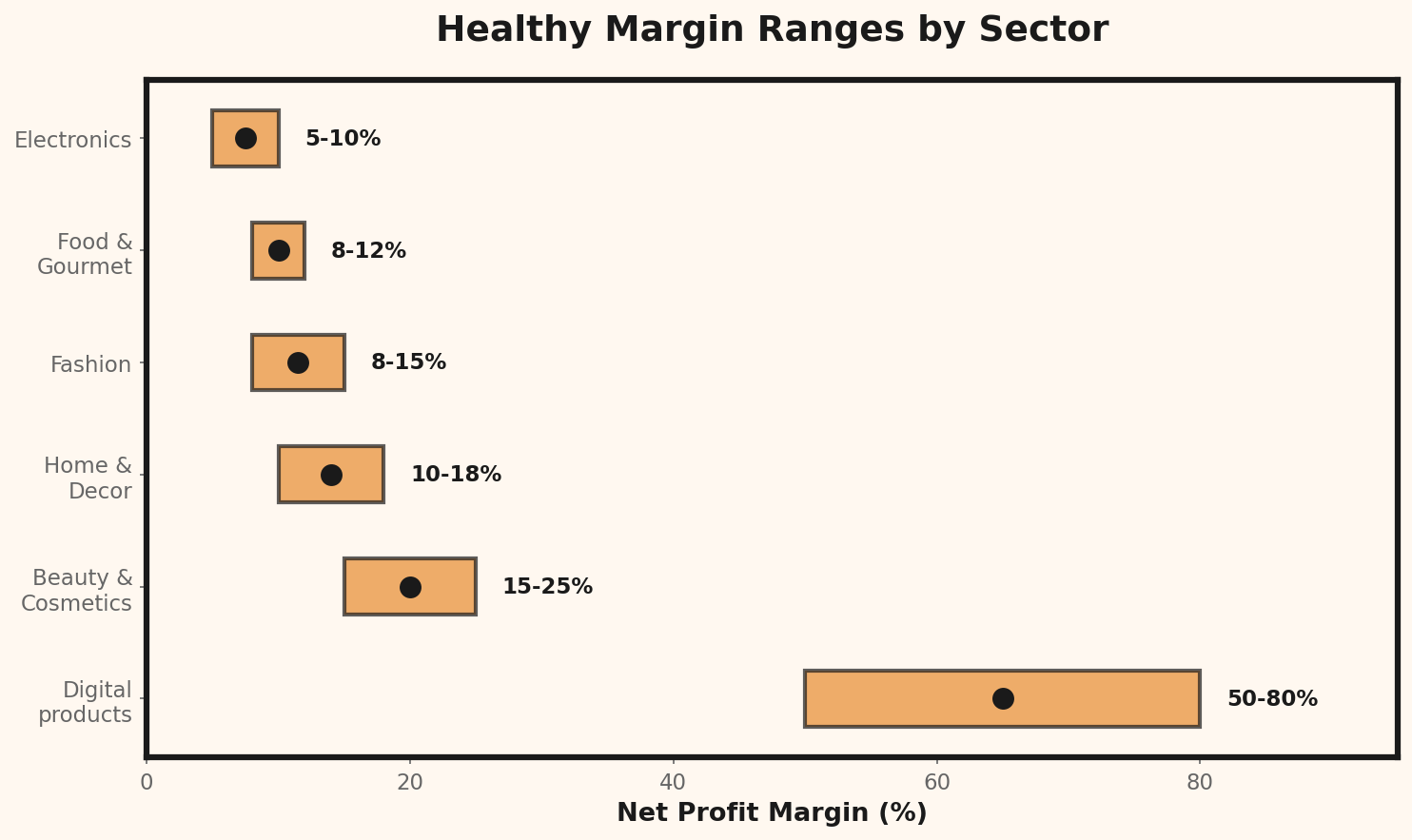
| Sector | Gross margin | Net margin (healthy) | Typical return rate | Key challenge |
|---|---|---|---|---|
| Fashion & accessories | 40% – 65% | 8% – 15% | 25% – 40% | High return rates |
| Electronics & gadgets | 15% – 30% | 5% – 10% | 10% – 15% | Fierce price competition |
| Cosmetics & personal care | 60% – 80% | 15% – 25% | 5% – 10% | Best sector for margins |
| Home & decor | 45% – 65% | 10% – 18% | 10% – 20% | Bulky shipping costs |
| Food & gourmet | 30% – 50% | 8% – 12% | 2% – 5% | Cold chain logistics |
| Digital products | 80% – 95% | 50% – 80% | 1% – 3% | Customer acquisition |
- Fashion and accessories: 8% – 15% net margin. High return rates (25-40%) destroy margins. Brands that keep returns under 15% consistently exceed 12%.
- Electronics and gadgets: 5% – 10%. Low starting gross margins, fierce price competition. Volume is what matters.
- Cosmetics and personal care: 15% – 25%. Low product costs, high loyalty, fewer returns. The best sector for margins.
- Home and decor: 10% – 18%. Good gross margins but shipping costs for bulky items significantly reduce net.
- Food and gourmet: 8% – 12%. Perishable products and cold chain logistics add layers of cost.
- Digital products: 50% – 80%. No shipping costs or physical inventory. If you can digitize part of your offering, do it.
7 ways to improve your margin without reducing quality
1. Optimize your shipping costs
Shipping is the biggest margin killer in ecommerce. Some tactics:- Negotiate volume rates with your logistics carrier. Starting from 100 monthly shipments, you already have negotiating power.
- Set a free shipping threshold (e.g., "Free shipping on orders over $75") to increase average order value.
- Consider custom packaging that reduces dimensional weight.
2. Reduce your return rate
Each return costs you between $10 and $30 when you factor in return shipping, inspection, repackaging, and potential loss of value. Invest in:- High-quality product photos (reduces returns by 22% according to Shopify)
- Detailed size guides (fashion)
- Product-in-use videos
- Honest and thorough descriptions
3. Review your customer acquisition costs
If you're spending more than 15% of the selling price to acquire each customer, something isn't working in your marketing funnel. Options:- Prioritize email marketing and SEO (near-zero marginal cost per conversion)
- Optimize your paid campaigns for ROAS, not clicks
- Invest in retention: a repeat customer has no additional acquisition cost
4. Implement tiered pricing
Instead of a uniform margin for all products, classify them:- Loss leaders (5-10% margin): attract traffic and new customers
- Core products (15-25% margin): your bread and butter
- Premium products (30-50% margin): where you actually make money
5. Negotiate better terms with suppliers
Not just unit price. Also negotiate:- Longer payment terms (improves your cash flow)
- Quarterly volume discounts
- Included shipping above a certain volume
- Return conditions for defective items
6. Automate repetitive operations
Every hour you spend packing orders, updating inventory, or answering generic emails is an hour you're not dedicating to high-value activities. Invest in:- Fulfillment automation (3PL starting at 200 orders/month)
- Chatbots for frequently asked questions
- Automatic inventory sync across channels
- Automated competitor price monitoring
7. Monitor your margins continuously
Margin isn't a number you calculate once. Costs change: shipping rates go up, suppliers adjust prices, your return rate fluctuates with the seasons. Establish a monthly ritual:BREAK-EVEN ANALYSIS — How many units to cover overhead
========================================
FIXED MONTHLY COSTS
Shopify plan: $29.00
Apps & tools: $80.00
Marketing budget (fixed portion): $500.00
Warehouse / storage: $200.00
Insurance: $50.00
--------
Total fixed monthly costs: $859.00
VARIABLE PROFIT PER UNIT
Net profit per unit (from above): $8.75
BREAK-EVEN POINT
$859.00 / $8.75 = 99 units per month
You must sell at least 99 units/month
just to cover your fixed overhead.
At 5 units/day, you need 20 selling days.
Below that? You're losing money.
========================================