|9 min read|Amara Winkler
Dynamic Pricing for Ecommerce: A Practical Guide for Small Online Stores
dynamic pricing ecommercepricing strategy online storedynamic pricing small businesscompetitive pricingecommerce pricing tacticsprice optimization

Source: Unsplash
What Dynamic Pricing Is (and What It Isn't)
What it is
Dynamic pricing is a strategy where a product's price changes based on factors like:- Demand: more demand → higher price (and vice versa)
- Competition: a competitor drops their price → you evaluate whether to follow
- Timing: Black Friday, peak season, day of the week
- Inventory: last units in stock → opportunity to raise the price (or lower it to liquidate)
- Segmentation: different prices for different geographic markets
What it isn't
- Not random changes. Every adjustment follows a defined logic.
- Not discriminatory pricing. Showing different prices to the same user in the same session is illegal in many jurisdictions.
- Not a race to the bottom. The goal isn't to always be the cheapest — it's to maximize margin on every sale.
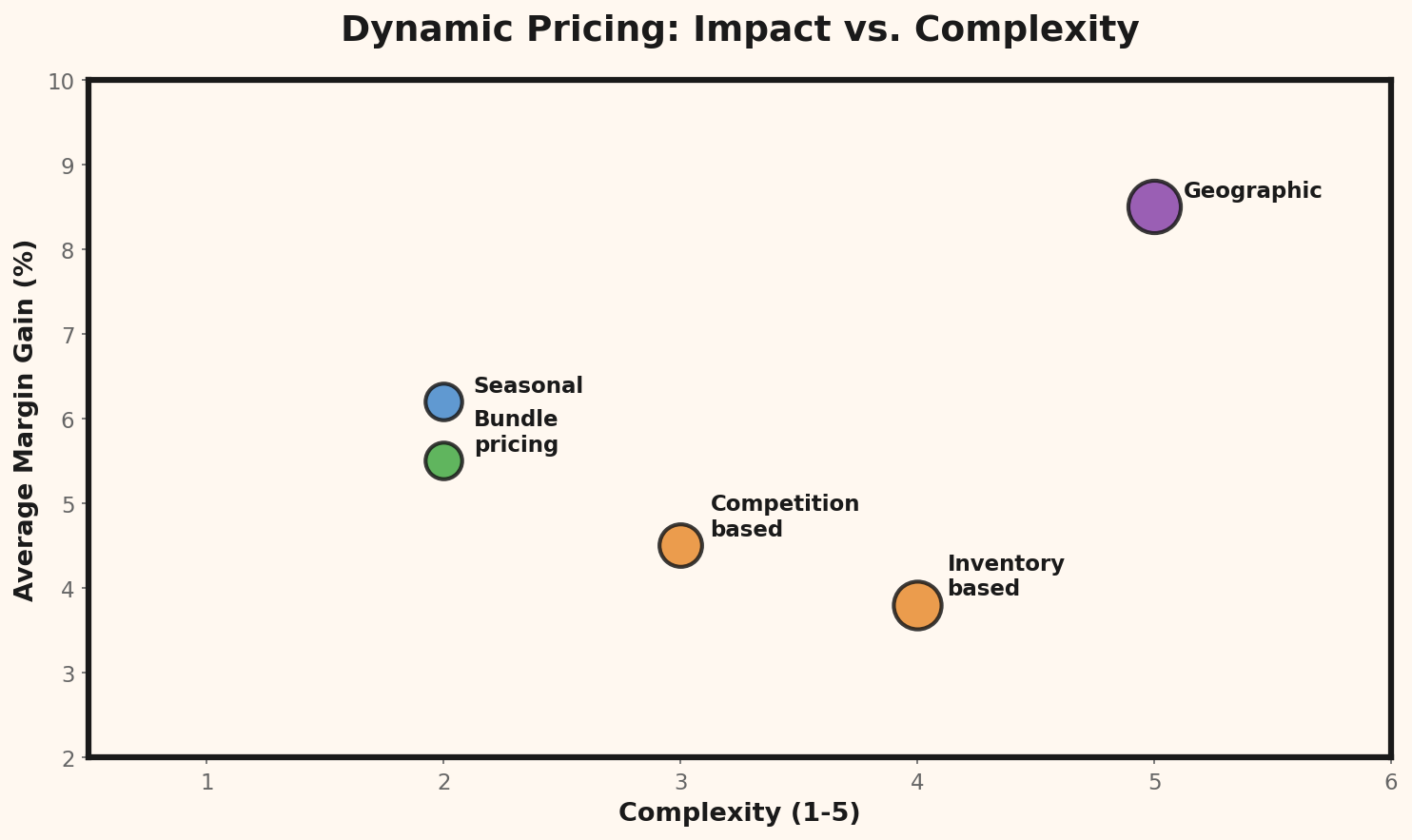
5 Dynamic Pricing Strategies for Small Stores
1. Competition-Based Pricing
The most accessible approach. Monitor your direct competitors' prices and adjust yours in response. How it works:2. Time-Based Pricing
Adjust prices based on the time of year, day of the week, or even time of day. How it works:Base price (year-round): $89.00
Peak season price (+8%): $96.12
Off-season price (-12%): $78.32
Estimated peak season sales (6 months): 120 units × $96.12 = $11,534
Estimated off-season sales (6 months): 40 units × $78.32 = $3,133
Annual total with dynamic pricing: $14,667
Compared to fixed price: 160 units × $89.00 = $14,240
Additional revenue: +$4273. Inventory-Based Pricing
Use stock levels as a signal to adjust prices. How it works:4. Geographic Segment Pricing
Different prices for different markets. Legal and common in international ecommerce. How it works:5. Bundle Pricing
Instead of lowering the price of an individual product, create packages that increase perceived value. How it works:Products separately:
Face cream: $22.00 (cost: $9.00)
Serum: $24.00 (cost: $10.00)
Cleanser: $16.00 (cost: $6.50)
Separate total: $62.00 (total cost: $25.50)
"Complete Routine Kit" bundle:
Bundle price: $52.00 (16.1% discount)
Total cost: $25.50
Bundle margin: $26.50 (51.0%)
Avg margin on individual products: 37.5% (at the lowest)
Source: Unsplash
Seasonal Pricing Calendar by Industry
Not every product follows the same seasonal pattern. Here is a reference calendar showing when to raise and lower prices by industry:| Industry | Peak Season (raise prices) | Off-Season (lower prices) | Key Events |
|---|---|---|---|
| Outdoor / Camping | Apr–Aug | Oct–Feb | Memorial Day, July 4th |
| Fashion / Apparel | Mar–May, Sep–Nov | Jan–Feb, Jun–Jul | Back to school, Holiday season |
| Electronics | Nov–Dec | Jan–Mar | Black Friday, Cyber Monday |
| Home & Garden | Mar–Jun | Nov–Jan | Spring cleaning, Moving season |
| Fitness / Sports | Jan–Mar | Jun–Aug | New Year resolutions |
| Toys & Games | Oct–Dec | Jan–Mar | Holiday gifting |
| Beauty / Cosmetics | Nov–Dec, Feb | Jul–Aug | Valentine's Day, Holidays |
Demand-Based Price Adjustment Formula
Use this calculation to determine your dynamic price based on current demand relative to your baseline:python# Demand-based dynamic pricing calculation
base_price = 89.00 # Your standard price in $
baseline_daily_sales = 5 # Average daily units sold
current_daily_sales = 8 # Current daily sales rate
Calculate demand multiplier
demand_ratio = current_daily_sales / baseline_daily_sales # 1.6
max_increase = 0.15 # Cap at 15% increase
max_decrease = 0.20 # Cap at 20% decrease
if demand_ratio > 1:
adjustment = min((demand_ratio - 1) 0.10, max_increase)
else:
adjustment = max((demand_ratio - 1) 0.15, -max_decrease)
dynamic_price = base_price * (1 + adjustment)
Example output:
demand_ratio = 1.6 → adjustment = +6.0%
dynamic_price = $89.00 × 1.06 = $94.34
print(f"Demand ratio: {demand_ratio:.1f}")
print(f"Price adjustment: {adjustment:+.1%}")
print(f"Dynamic price: ${dynamic_price:.2f}")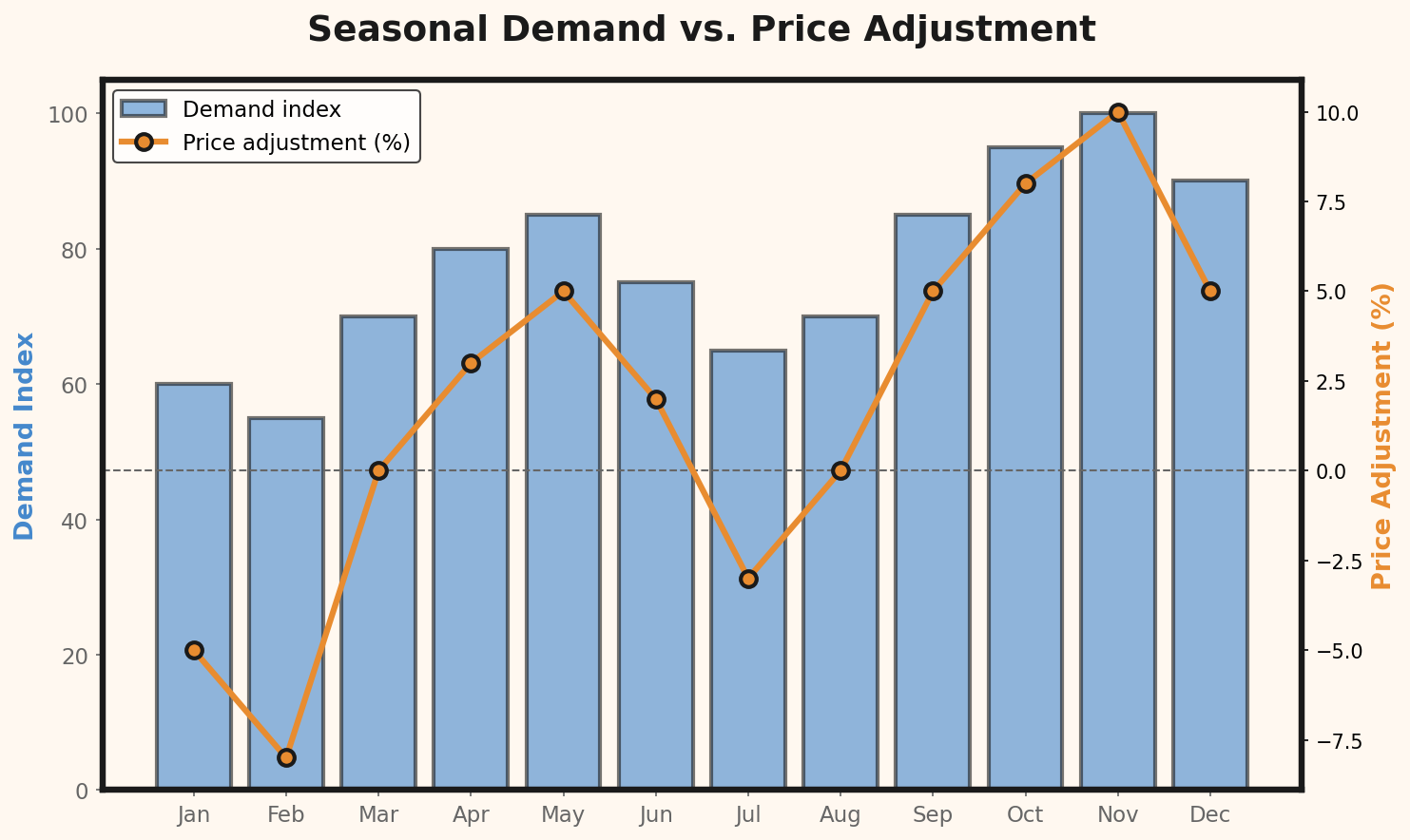
How to Implement Dynamic Pricing Step by Step
Step 1: Define Your Pricing Rules
Don't change prices on impulse. Write down your rules:- Competition rule: "If 2+ competitors drop more than 5%, I evaluate within 48 hours"
- Timing rule: "+8% in peak season, -10% in off-season"
- Inventory rule: "Progressive discount if stock sits for 30+ days without movement"
- Absolute minimum price: "Never below cost + 15% margin"
Step 2: Start with 10 Products
Don't try to apply dynamic pricing to your entire catalog at once. Pick your top 10 products (the ones generating 80% of your revenue) and test for one month.Step 3: Monitor the Competition
You can't adjust prices without knowing what your competition is doing. Use a price monitoring tool that covers your competitors' platforms.Step 4: Measure the Impact
Compare these KPIs before and after:- Gross margin per product
- Conversion rate
- Revenue per visitor
- Inventory turnover rate
Step 5: Scale Gradually
Once validated with 10 products, expand to 25, then 50. Adjust the rules based on what you learn along the way.Mistakes to Avoid
The "always cheaper" mistake
If your response to every competitor price drop is to lower yours, you're in a destructive spiral. Dynamic pricing doesn't mean always being the cheapest — it means being competitively smart.The excessive frequency mistake
Changing prices every hour confuses your customers and can erode trust. For a small store, weekly or biweekly adjustments are enough.The ignoring perceived value mistake
Price is just one factor. If your competitor sells at $20 with 3/5 star ratings, and you sell at $24 with 4.8/5 ratings, you don't need to lower your price. Perceived value justifies the difference.The not communicating mistake
If you raise prices, communicate it: better quality, new formulation, faster shipping. Customers accept price increases when they understand the reason.Tools You Need
To implement dynamic pricing in a small store, you need:Dynamic Pricing Tools Comparison
| Tool | Best For | Price Range | Key Feature |
|---|---|---|---|
| Undercut | Small shops, multi-platform monitoring | Free – $25/mo | Automatic competitor price alerts |
| Prisync | Mid-size ecommerce | $99–$399/mo | MAP monitoring |
| Competera | Enterprise retailers | Custom pricing | AI-driven pricing |
| Price2Spy | Agencies, multi-client | $24–$278/mo | Marketplace coverage |
| Keepa | Amazon sellers only | Free – $19/mo | Historical price charts |
| Manual (Spreadsheet) | Micro stores (<20 products) | Free | Full control, no automation |