|10 min read|Verena Merklinghaus
Psychological Pricing: 7 Techniques That Boost Your Online Sales
psychological pricingpricing techniquesecommerce pricing psychologyincrease sales pricingcharm pricingprice anchoring

Source: Unsplash
1. Charm Pricing: The Power of the Number 9
Charm pricing is the best-known technique — and it still works remarkably well. The principle is simple: a price ending in 9 or 99 is perceived as significantly lower than a round number.Why It Works
Our brains read numbers from left to right. When we see $29.99, the brain first registers "twenty something." Faced with $30.00, it registers "thirty." The actual difference is one cent. The perceived difference is an order of magnitude.The Numbers That Prove It
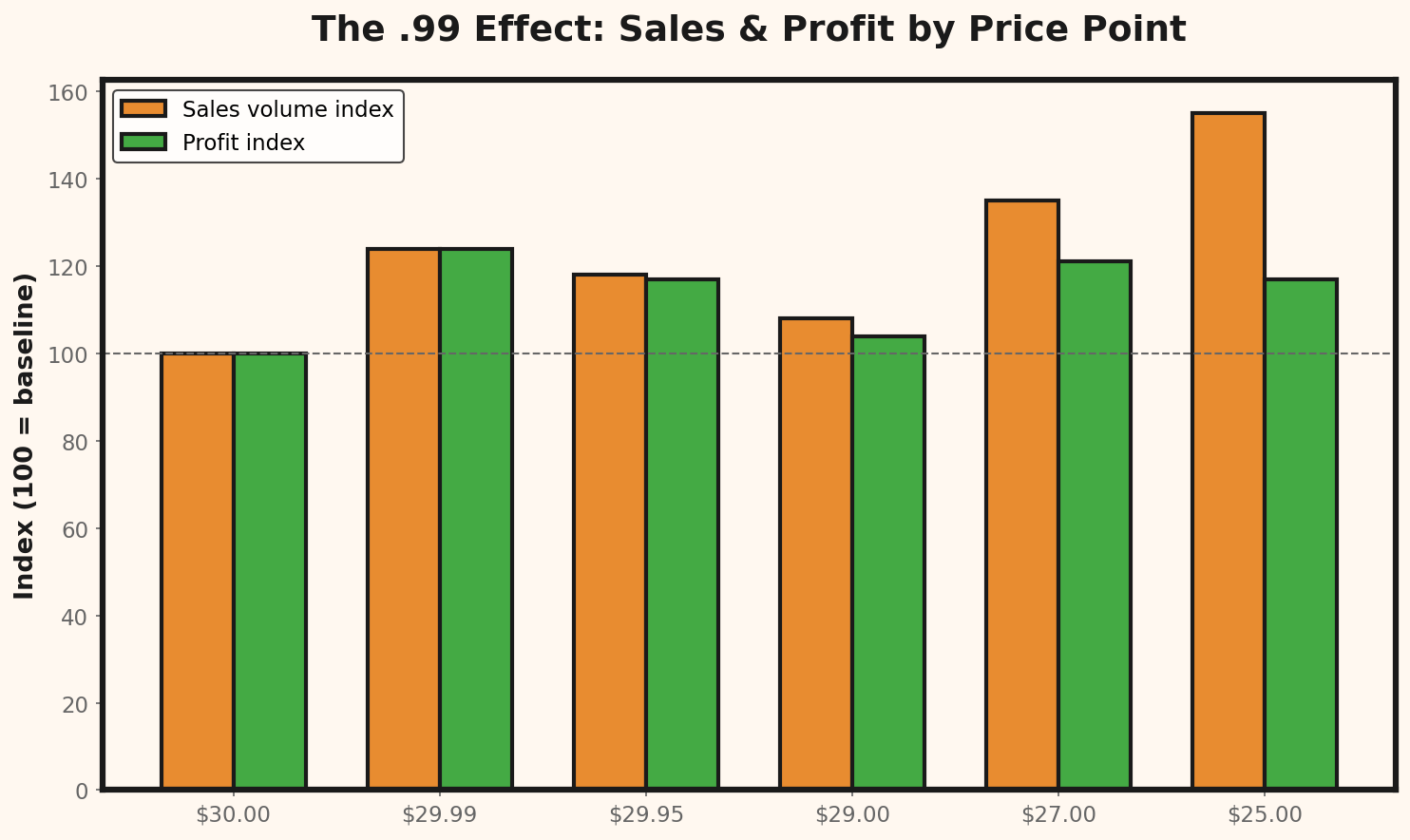
A classic study by MIT and the University of Chicago tested a women's clothing item at three prices: $34, $39, and $44. The result? The $39 price generated the most sales — more than the lower $34 price. The trailing 9 acts as a bargain signal. In ecommerce, A/B tests consistently show that charm pricing increases conversions by 8 to 24% depending on the product category.Practical Application
- Entry-level products: end with .99 ($19.99, $29.99)
- Mid-range products: end with .95 ($49.95, $79.95)
- Premium products: use round prices ($150, $500) — prestige justifies roundness
2. Price Anchoring: The Power of the Crossed-Out Price
Anchoring is a powerful cognitive bias. The first price a customer sees becomes their mental reference point. Everything that follows is evaluated against that anchor. That's why the crossed-out price is so effective. When a customer sees "~~$89.00~~ $59.99", they don't judge $59.99 in absolute terms. They compare it to $89 and perceive a substantial saving.Anchoring Impact Calculation
Let's look at the concrete effect on a catalog of 200 products:Scenario: Store with 200 products, 5,000 visitors/month
WITHOUT price anchoring:
Average conversion rate : 2.1%
Visitors : 5,000
Orders : 105
Average order value : $65.00
Monthly revenue : $6,825.00
WITH price anchoring (crossed-out price + new price):
Average conversion rate : 2.9% (+38%)
Visitors : 5,000
Orders : 145
Average order value : $68.50 (+5.4% thanks to the "bargain" effect)
Monthly revenue : $9,932.50
Monthly difference : +$3,107.50
Annual difference : +$37,290.00Golden Rules of Anchoring
- The anchor must be credible — a crossed-out price of $200 for a product worth $20 destroys trust
- Display the percentage saved alongside the crossed-out price (e.g., "-33%")
- Place the old price to the left or above the new price
3. Bundle Pricing: Sell More Through Packages
Bundle pricing involves grouping multiple products into a single offer at a price perceived as a great deal. The customer feels they're getting a bargain, and you increase your average order value.Bundle Profitability Calculation
Product A (face cream)         : Unit price $24.99 | Cost $8.50
Product B (serum)              : Unit price $34.99 | Cost $11.00
Product C (cleanser)           : Unit price $14.99 | Cost $4.50

Buying all 3 separately       :
  Total revenue                : $74.97
  Total cost                   : $24.00
  Gross margin                 : $50.97 (68.0%)

"Complete Routine" bundle      :
  Bundle price                 : $59.99 (-20% displayed)
  Total cost                   : $24.00
  Gross margin                 : $35.99 (60.0%)

But here's the real effect:
  Without bundle: 18% of customers buy 2+ products
  With bundle: 41% of customers choose the bundle

  100 customers WITHOUT bundle :
    82 x one product (avg. $24.99) = $2,049.18
    18 x two products (avg. $47.49) = $854.82
    Total revenue = $2,904.00

  100 customers WITH bundle    :
    59 x one product (avg. $24.99) = $1,474.41
    41 x bundle ($59.99) = $2,459.59
    Total revenue = $3,934.00

Revenue increase : +35.4%Effective Bundle Types
- Pure bundle: products are only available together (rare in ecommerce)
- Mixed bundle: products are available individually AND as a bundle (recommended)
- BOGO bundle: "Buy 2, get the 3rd free" — very effective for consumables
4. Prices Ending in 7: The Alternative to Charm Pricing
While charm pricing at .99 is everywhere, prices ending in 7 are gaining ground. Why? Because consumers have grown skeptical of the ubiquitous .99.The Distinction Effect
A price of $47 or $27 stands out visually in search results where every competitor lists $49.99 or $29.99. The number 7 is perceived as:- More authentic — as if the price was precisely calculated rather than artificially rounded
- More memorable — the brain retains unusual numbers better
- Lower — $47 is perceived as significantly less than $49.99, even though the difference is only $2.99
When to Use 7
- Digital products and subscriptions ($17/month, $47/year, $97 for a course)
- Services and custom offerings
- Artisan products where a "calculated" price reinforces authenticity

Source: Unsplash
5. Free Shipping Threshold: The Average Order Value Lever
Conditional free shipping is one of the most powerful levers in ecommerce. 73% of online shoppers say free shipping influences their purchase decision, and 58% add items to their cart to reach the threshold.How to Set the Right Threshold
The rule is simple: set your free shipping threshold 20-30% above your current average order value.- Current average order value: $35 --> Threshold: $45
- Current average order value: $60 --> Threshold: $75
- Current average order value: $120 --> Threshold: $149
Mistakes to Avoid
- Threshold too high: if the customer needs to double their cart, they'll abandon rather than add a product
- No progress bar: always display "Only $X left for free shipping!" in the cart
- Non-round threshold: use round numbers ($49, $75, $99) that are easy to remember
6. Urgency and Scarcity: FOMO in the Service of Pricing
The fear of missing out (FOMO) is a formidable purchase driver. Limited-time or limited-quantity offers exploit this mechanism.Urgency Techniques Applied to Pricing
Countdown timers on promotions: A visible timer ("This offer expires in 2h 14min") increases conversions by 9 to 15% according to Baymard Institute studies. Limited stock display: "Only 3 left in stock" creates a sense of immediate urgency. Amazon uses this technique extensively, and it works just as well for small stores. Time-declining prices: A price that increases in tiers (launch at $39, then $49, then $59) encourages early buyers to act fast.Ethical Guidelines
Artificial urgency destroys trust. If your "limited offer" returns every week, customers notice. Use urgency sparingly and honestly:- Countdown timers must be real
- Displayed quantities must reflect actual stock
- Promotions advertised as exceptional must not repeat identically
7. Tiered Pricing: Three Levels to Guide the Choice
Tiered pricing involves offering 3 options at increasing price points. This technique exploits the compromise effect: when faced with three choices, most customers choose the middle option.Why Three Levels
- The low option exists to make the middle option attractive
- The middle option is your target offer — the one you want to sell
- The high option exists to make the middle option seem reasonable
Ecommerce Application
Even if you don't sell subscriptions, tiered pricing applies:- Product sizes: 100 ml at $12, 250 ml at $22, 500 ml at $38
- Service levels: standard, premium, VIP
- Quantity packs: 1 unit, 3 units (-10%), 6 units (-20%)
Summary Table of the 7 Techniques
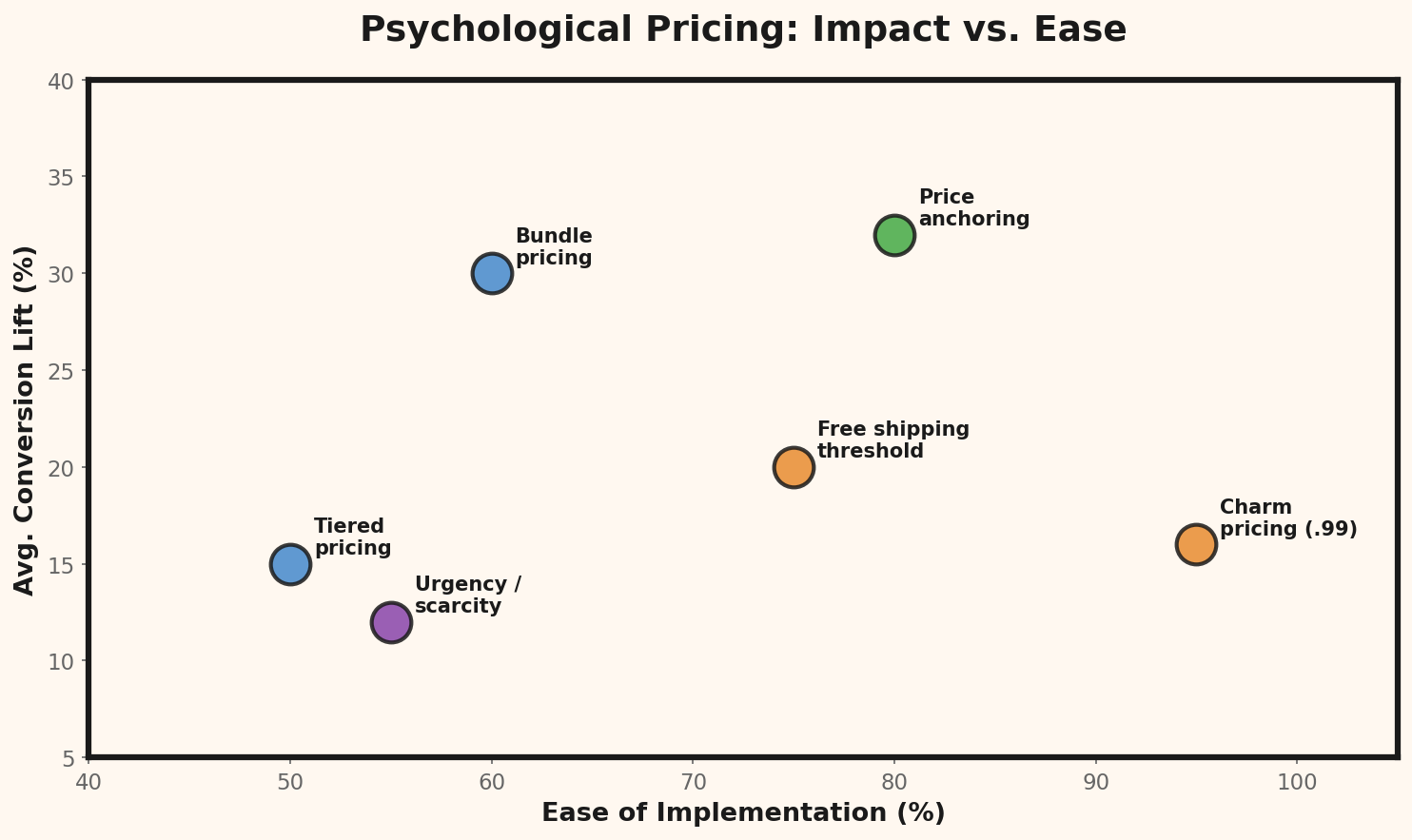
| # | Technique | Impact on Conversions | Ease of Implementation | Ideal For |
|---|---|---|---|---|
| 1 | Charm pricing (.99) | +8 to 24% | Very easy | Mass-market products, entry-level |
| 2 | Price anchoring (crossed-out price) | +25 to 40% | Easy | Promotions, clearance, launches |
| 3 | Bundle pricing (packages) | +25 to 35% average order value | Medium | Cosmetics, food, consumables |
| 4 | Prices ending in 7 | +5 to 12% | Very easy | Digital products, services, artisan goods |
| 5 | Free shipping threshold | +15 to 25% average order value | Easy | Any store with paid shipping |
| 6 | Urgency and scarcity | +9 to 15% | Medium | Seasonal offers, launches, limited stock |
| 7 | Tiered pricing (3 levels) | +10 to 20% | Medium | Subscriptions, packs, services |
Charm Pricing Revenue Impact Calculation
How much additional revenue can charm pricing generate? Here is a concrete calculation for a typical online store:Charm Pricing Revenue Impact Calculator
========================================
Store baseline:
Monthly visitors : 10,000
Current conversion rate : 2.0%
Current orders/month : 200
Average product price : $45.00
Average items per order : 1.8
Monthly revenue : $16,200.00
After applying charm pricing ($44.99 instead of $45.00):
New conversion rate : 2.3% (+15%)
New orders/month : 230
Average product price : $44.99 (-$0.01)
Average items per order : 1.85 (+2.8% impulse effect)
Monthly revenue : $19,154.82
Net monthly gain : +$2,954.82
Net annual gain : +$35,457.80
Revenue per $0.01 price drop : $2,954.82
ROI: Infinite (zero cost to implement)
Source: Unsplash
A/B Test Results: Price Endings Compared
Real-world A/B testing reveals significant differences between price ending strategies. Here are aggregated results across multiple ecommerce categories:| Price Ending | Example Price | Conversion Rate | Perceived Value | Best For | Trust Score |
|---|---|---|---|---|---|
| .99 (charm) | $29.99 | +18% vs round | Low/bargain | Mass market, entry-level | Medium |
| .95 | $29.95 | +12% vs round | Moderate | Mid-range, fashion | High |
| .97 | $29.97 | +9% vs round | Calculated/fair | Digital products, services | Very high |
| .00 (round) | $30.00 | Baseline | Premium/luxury | High-end, prestige brands | Very high |
| .90 | $29.90 | +7% vs round | Moderate discount | European markets | High |
| .49 | $29.49 | +5% vs round | Mid-range bargain | Groceries, consumables | Medium |