|4 min read|Joana Manjapane
Pricing strategy for your webshop: how to maximize your margins
pricing strategy webshopwebshop pricingmaximize marginscompetitor pricinge-commerce pricingonline pricing strategy

Source: Unsplash
Step 1: Know your real costs
Most webshop owners underestimate their actual cost per product. Direct costs per unit:- Purchase price
- Inbound shipping to warehouse
- Packaging
- Platform fees (Shopify, WooCommerce, etc.)
- Payment processing fees (credit card, PayPal)
- Return rate (average 10–15% in e-commerce)
Purchase price:        $15.00
Inbound shipping:       $2.00
Packaging:              $1.50
Platform fee (3%):      $1.20 (at $40 selling price)
Returns (12%):          $1.80

Actual cost: $21.50Step 2: Analyze your competition
You can only set a smart price when you know what the market is charging.
Source: Unsplash
- Google Shopping — most direct
- Comparison sites (PriceGrabber, Shopzilla)
- Amazon and eBay — if your competitors sell there
- Direct webshops — manually or via monitoring tools
Build a price matrix
| Product | Your price | Competitor A | Competitor B | Market average |
|---|---|---|---|---|
| Product X | $39.99 | $35.00 | $42.99 | $39.33 |

Source: Unsplash
Step 3: Choose your pricing strategy
Strategy 1: Competition-based pricing
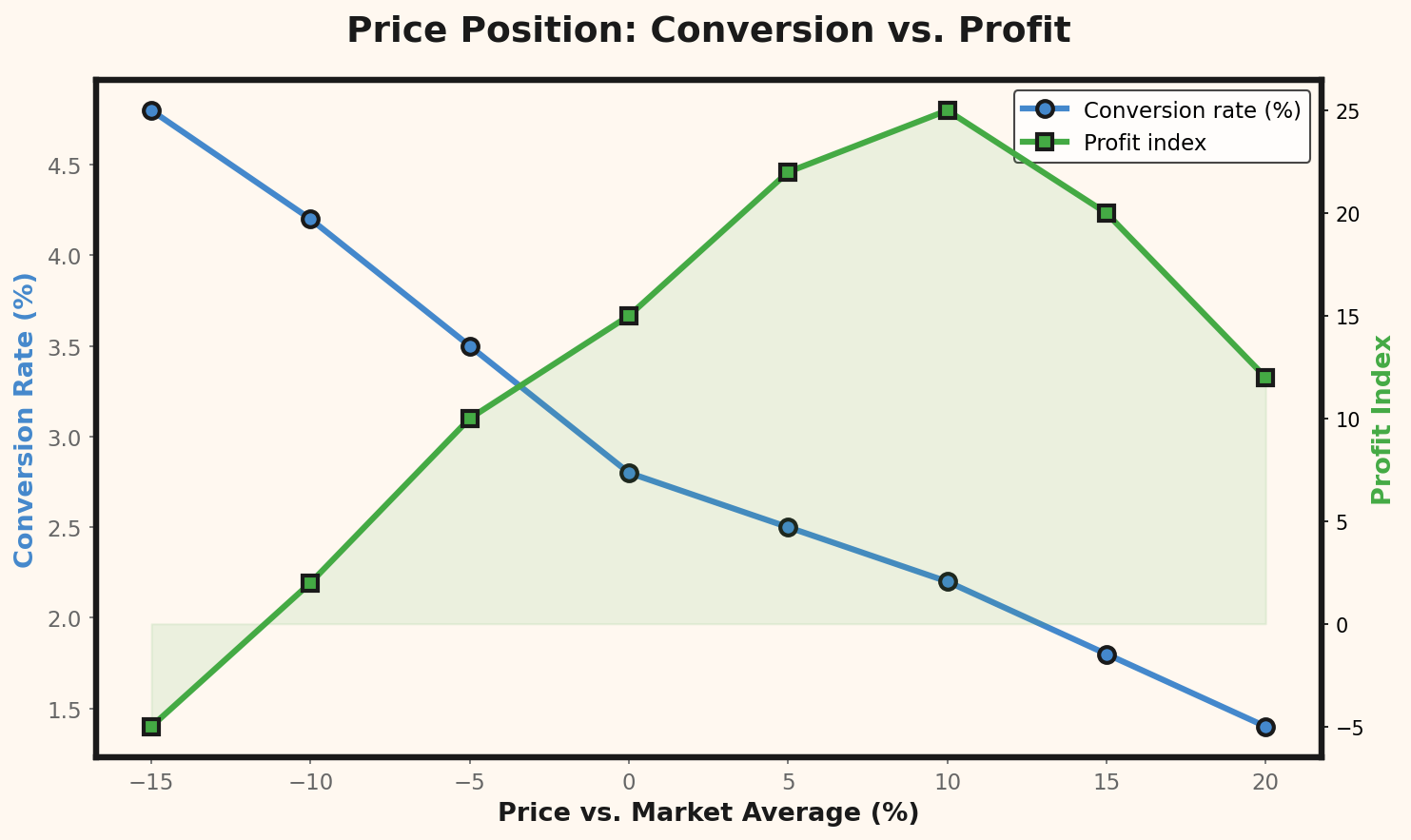
Position your price relative to the market:- Price leader: 5–15% below the average
- Market rate: within 3% of the average
- Premium: 10–30% above the average
Market average:   $39.33
Premium +20%:     $47.20  (rounded: $47.99)

Your costs:       $21.50
Premium margin:   $47.99 − $21.50 = $26.49 (55%)
Market-rate margin: $39.99 − $21.50 = $18.49 (46%)
→ Premium yields $8.00 extra margin per saleStrategy 2: Psychological pricing
- $29.99 instead of $30 — the left-digit effect still works
- Crossed-out original price — make sure the original price is real (FTC guidelines!)
- Bundles: make direct comparison harder by offering unique combinations
- Free shipping over $50 — if your average order value is $35, it will rise
Bundle pricing example
Bundling products is one of the most effective ways to increase average order value while making direct price comparison nearly impossible. Here is how a simple bundle calculation works:Product A (standalone): $24.99
Product B (standalone): $19.99
Product C (standalone): $14.99
Combined price: $59.97
Bundle price: $49.99 (17% discount)
Your cost for all 3: $28.50
Bundle margin: $49.99 − $28.50 = $21.49 (43%)
Without bundle (avg 1.2 items): $24.99 × 1.2 = $29.99 revenue
With bundle: $49.99 revenue (+67%)Strategy 3: Dynamic pricing
Adjust prices based on:- Season (higher during peak periods)
- Inventory (last items = higher price or clearance sale)
- Day of the week
Margin improvement tactics
| Tactic | Impact on margin | Effort | Timeframe |
|---|---|---|---|
| Raise prices 5-10% on low-elasticity products | High (+5-10% margin) | Low | Immediate |
| Introduce bundles | High (+15-25% AOV) | Medium | 2-4 weeks |
| Remove free shipping, add threshold | Medium (+3-5% margin) | Low | Immediate |
| Implement psychological pricing (.99) | Low-Medium (+1-3% conversion) | Low | Immediate |
| Dynamic pricing by season | Medium (+5-15% peak margin) | High | 1-3 months |
| Cut underperforming SKUs | High (+8-12% avg margin) | Medium | 2-4 weeks |
Pricing tier strategy comparison
| Strategy | Best for | Risk level | Margin potential | Customer loyalty |
|---|---|---|---|---|
| Price leader | High volume, low cost | High | Low (15-25%) | Low |
| Market rate | Broad market, safe growth | Low | Medium (30-40%) | Medium |
| Premium | Niche, strong brand | Medium | High (45-60%) | High |
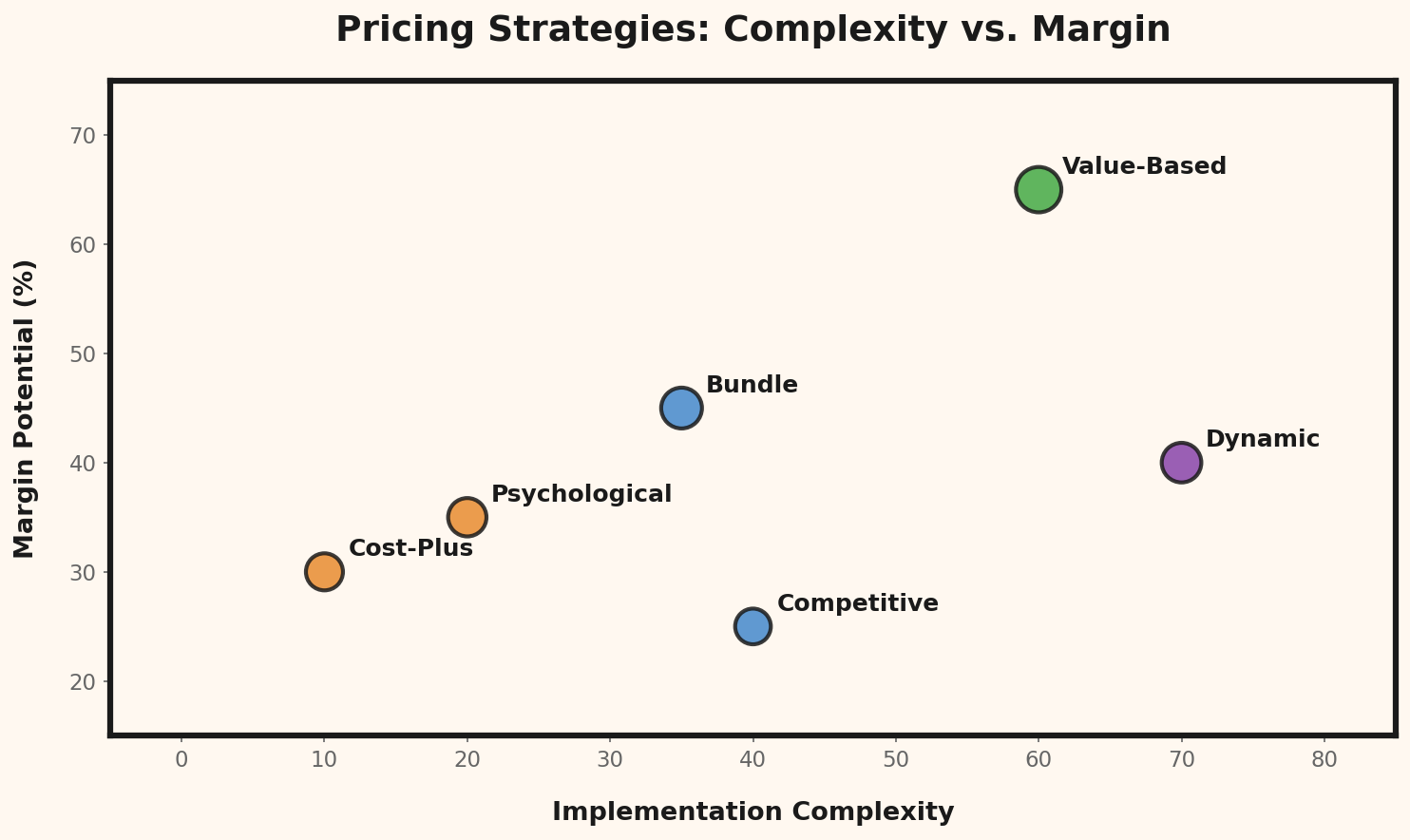
| Value-based | Unique products, high demand | Low | Very high (50-70%) | Very high |