
|5 min read|Joana Manjapane
Monitor Competitor Prices: Complete Guide for E-Commerce Sellers
monitor competitor pricesprice monitoringecommerce pricing strategycompetitor price trackingprice intelligencecompetitive pricing

Source: Unsplash
Why Monitor Your Competitors' Prices?
The Cost of Not Knowing
A McKinsey study shows that a 1% change in price impacts profit by 11% on average. In e-commerce, prices change daily. Not monitoring them is like flying blind.Three Scenarios That Cost You Money
Scenario 1: You're overpriced without knowing it. Your competitor has dropped their price. Your conversion rate slowly declines, but you blame it on seasonality. Scenario 2: You're too cheap. All your competitors have raised their prices except you. You're selling well, but leaving margin on the table. Scenario 3: A new competitor appears. A dropshipper discovers your niche and undercuts prices. If you don't detect them for weeks, they've already established themselves in search results.The 4 Methods of Price Monitoring
Method 1: Manual Monitoring
The simplest but most time-consuming.- Visit the websites of 3-5 competitors
- Record prices in a spreadsheet
- Repeat weekly
Method 2: Browser Extensions

Source: Unsplash
Method 3: Price Comparison Platforms
Google Shopping, PriceGrabber, Shopzilla — these platforms show prices from multiple sellers. Use them to:- See your price positioning
- Detect new competitors
- Track price trends
Method 4: Specialized Tools
For shops with more than 100 products, professional tools pay for themselves:| Tool | Price | Specialty |
|---|---|---|
| Prisync | $99/month | Intuitive interface, good coverage |
| Price2Spy | $24/month | More affordable, strong in Europe |
| Keepa | $19/month | Amazon only |
The ROI of Price Monitoring
Before investing time or money in monitoring tools, it helps to understand the potential return on investment.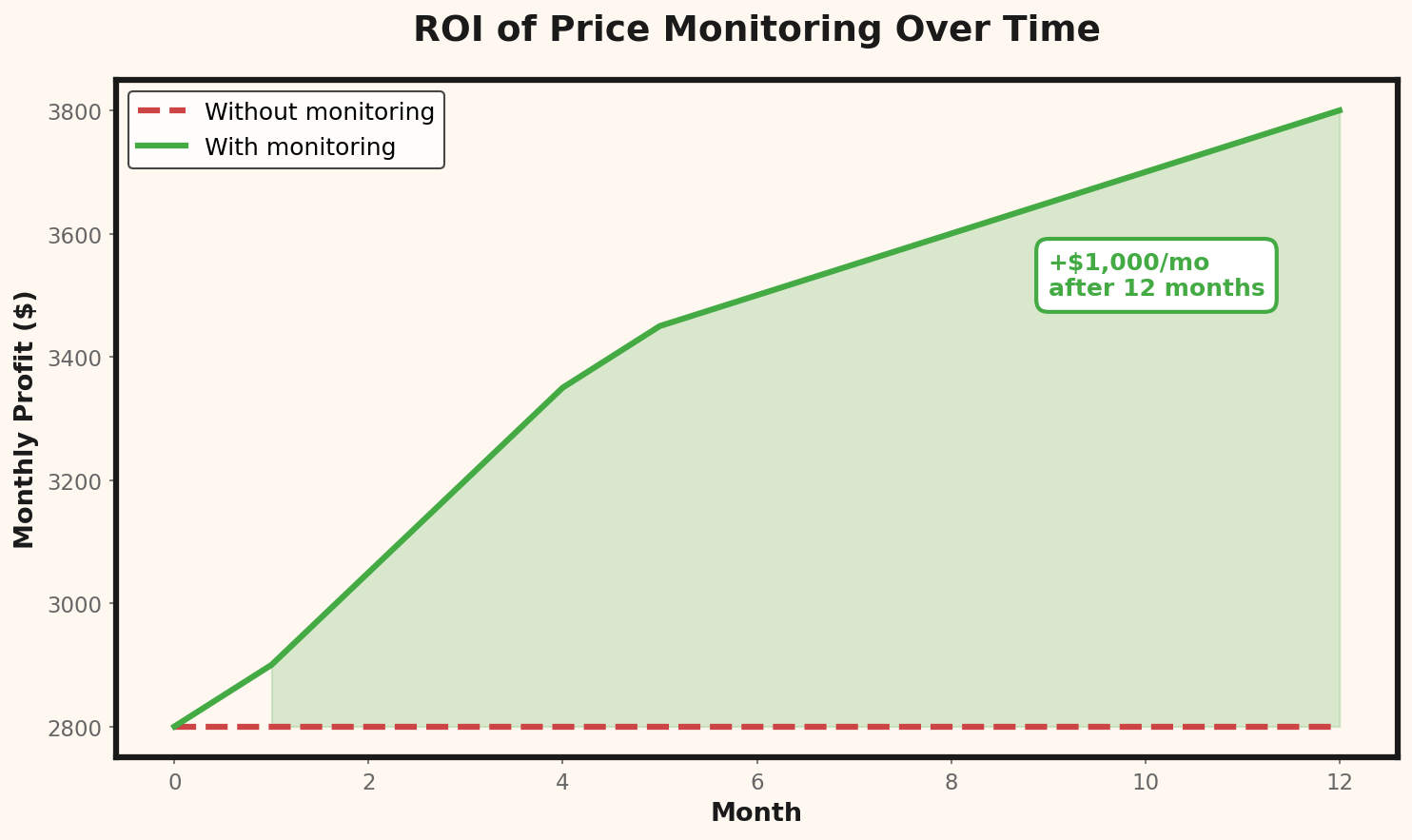
Monitoring ROI Calculation:
──────────────────────────────────────
Monthly revenue:                 $50,000
Products monitored:                  100
Average price adjustment:           +2.3%
Revenue gained from adjustments: $1,150/month

Monitoring cost (tool):           $99/month
Time cost (2 hrs/week × $30/hr): $240/month
Total investment:                $339/month

Net monthly gain:                $811/month
Annual ROI:                        340%
──────────────────────────────────────
→ Even modest price adjustments pay for themselves quickly
Price Reaction Strategy Framework
Not every price change deserves the same response. Use this framework to decide your reaction.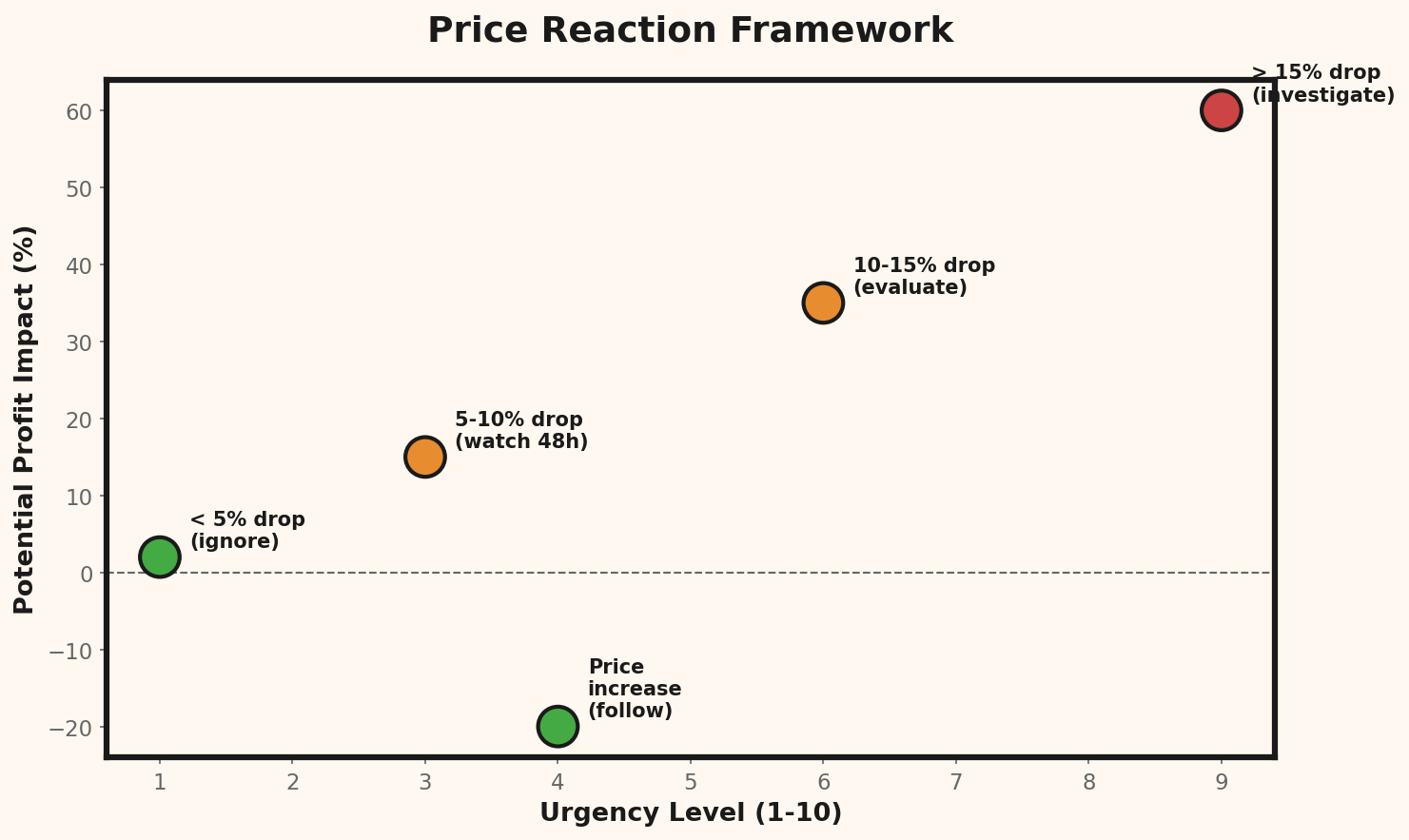
| Price Change Type | Example | Recommended Reaction | Urgency |
|---|---|---|---|
| Small drop (1-5%) | Competitor goes from $30 to $28.50 | Monitor, don't react | Low |
| Moderate drop (5-15%) | Competitor goes from $30 to $26 | Watch 48h, then decide | Medium |
| Large drop (>15%) | Competitor goes from $30 to $24 | Analyze immediately, check stock levels | High |
| Price increase | Competitor goes from $30 to $33 | Consider following to gain margin | Medium |
| New competitor enters | Unknown seller at $22 | Evaluate product quality and reviews first | Low |
| Shipping change | Competitor adds free shipping | Recalculate total cost, adjust if needed | Medium |
How to Organize Your Price Monitoring
Step 1: Identify Your 20 Key Products
The 80/20 rule applies: 20% of your products generate 80% of your revenue. Start with those.Step 2: Find Your Direct Competitors
For each product, identify 3-5 competitors who:- Sell similar products
- Target the same audience
- Appear in the same Google results
Step 3: Create Your Dashboard
A simple spreadsheet is enough to start:| Product | Your Price | Competitor A | Competitor B | Average |
|---|---|---|---|---|
| Product X | $29.99 | $27.50 | $32.00 | $29.83 |
Step 3b: Calculate the Impact of a Price Adjustment
Before changing a price, estimate the effect on your margin:Product: current price $29.99 | cost $18.00
Current margin: 29.99 - 18.00 = $11.99 (40%)
If you drop to $27.50 to match Competitor A:
New margin: 27.50 - 18.00 = $9.50 (34.5%)
Margin loss: -$2.49 per sale (-21%)
→ You need to sell 26% more to offset the reductionStep 4: Define Your Reaction Rules
Before you receive your first alert, decide:- 5-10% drop: Watch for 48 hours (temporary promotion?)
- Drop > 15%: Analyze immediately
- Price increase: Consider following (more margin)
Step 5: Plan the Frequency
| Shop Size | Recommended Frequency |
|---|---|
| < 50 products | Weekly |
| 50-200 products | Twice a week |
| 200+ products | Daily (automated) |
Mistakes to Avoid
Mistake 1: Reacting to every change. Not all price drops are strategic. Temporary promotions, pricing errors, and clearance sales don't justify a reaction. Mistake 2: Ignoring total cost. A competitor at $25 + $6 shipping is more expensive than you at $29 with free shipping.Real total cost comparison:
Competitor: $25.00 + $6.00 (shipping) = $31.00
You: $29.00 + $0.00 (free shipping) = $29.00
→ You're $2.00 cheaper despite a higher listed price