
|6 min read|Joana Manjapane
How to Spy on Competitor Prices Legally
spy on competitor pricesmonitor competitor pricingcompetitor price trackingcompetitive intelligence ecommercepricing intelligenceprice monitoring tools

Source: Unsplash
Is It Legal to Monitor Competitor Prices?
Yes, in most cases. Prices published on an online store are public information. Anyone can see them. Writing them down, comparing them, and making business decisions based on them is perfectly legal. However, there are nuances:What You CAN Do
- Manually visit competitor stores and note their prices
- Use tools that access public information (prices visible to any visitor)
- Compare prices on portals like Google Shopping, Idealo, PriceGrabber, etc.
- Analyze historical price trends with tools like Keepa
What You Should NOT Do
- Access password-protected areas without authorization
- Violate a platform's terms of service in a way that causes harm
- Extract data at a rate that overloads a competitor's servers (DoS)
- Use pricing data for price-fixing agreements with competitors
Legal vs. Illegal Monitoring Methods
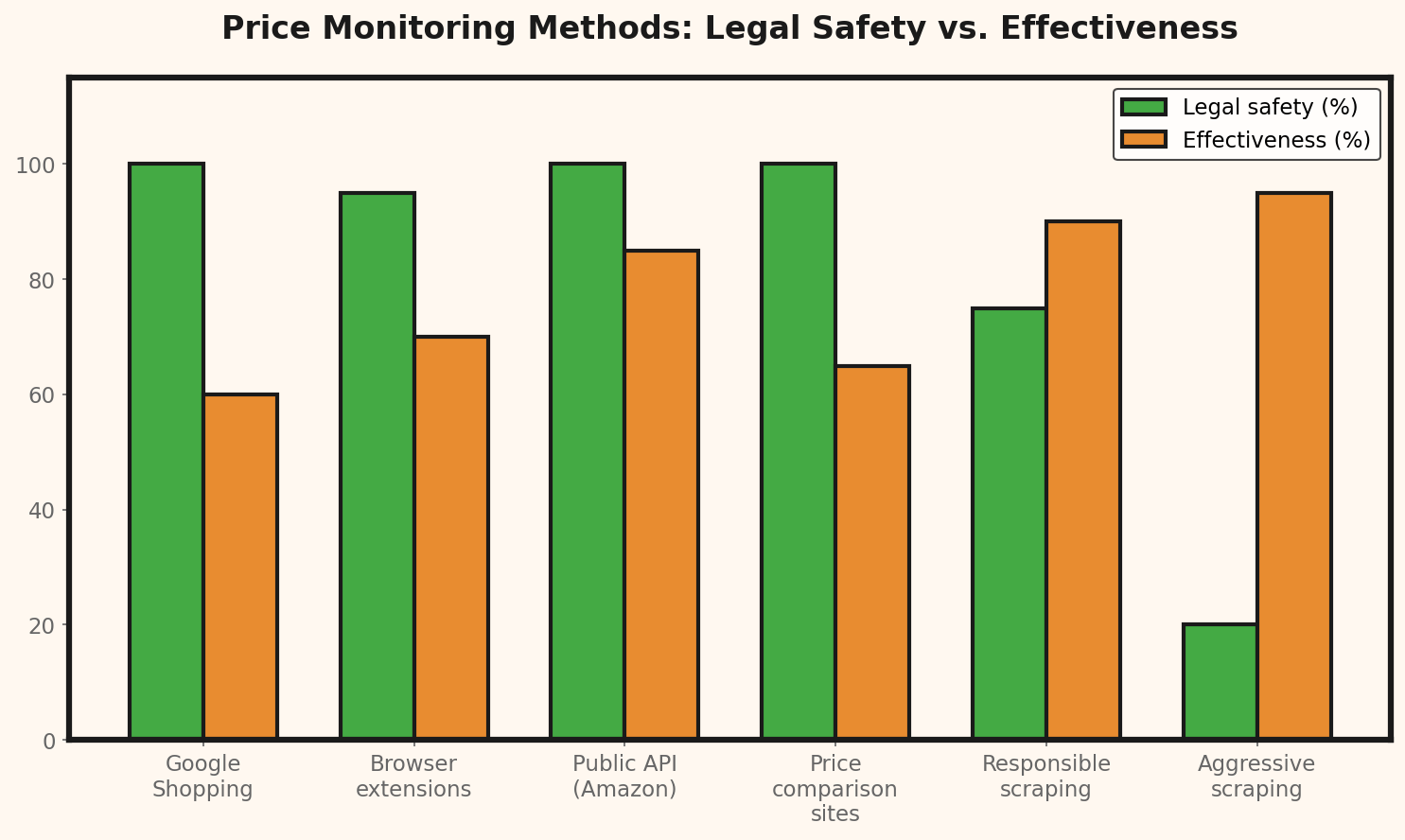
Before diving into specific methods, here is a clear overview of what is legally safe versus what crosses the line:| Method | Legal Status | Risk Level | Notes |
|---|---|---|---|
| Google Shopping / price comparison sites | Legal | None | Public aggregated data |
| Browser extensions (Keepa, Honey) | Legal | None | Accesses visible page data |
| Price intelligence tools (Prisync, etc.) | Legal | Low | Public data, standard requests |
| Public marketplace APIs | Legal | None | Official, rate-limited access |
| Responsible scraping (robots.txt compliant) | Legal | Low | Must respect server limits |
| Aggressive scraping (high frequency) | Risky | High | Can violate ToS, cause DoS |
| Scraping behind login walls | Illegal | Very High | Unauthorized access |
| Price fixing with competitors | Illegal | Extreme | Criminal offense (antitrust) |
| Copying product catalogs/descriptions | Illegal | High | Copyright infringement |
5 Legal Methods to Monitor Prices
1. Google Shopping and Price Comparison Sites
The simplest and most straightforward legal method. Google Shopping displays prices from multiple sellers for the same product. How to use it:
Source: Unsplash
Source: Unsplash
2. Browser Extensions
Tools like Keepa, Honey, or Visualping let you monitor prices directly from your browser. Distill Web Monitor is especially useful: you select the price element on a competitor's page and receive a notification whenever it changes.3. Price Intelligence Tools
Prisync, Price2Spy, and similar platforms automate the process. You enter competitor URLs and the tool extracts prices on a regular schedule. Legality: These tools access public information, just like a regular browser would. It's legal as long as they don't deliberately violate the platform's terms of service.4. Public Marketplace APIs
Amazon, eBay, and other marketplaces offer APIs that provide official, controlled access to pricing data. Amazon Product Advertising API: Lets you retrieve prices, availability, and more. Requires an affiliate account.5. Responsible Scraping
Web scraping (automated data extraction) is legal in many jurisdictions, but with conditions:- Respect
robots.txt - Don't overload servers
- Only extract publicly accessible data
- Don't circumvent technical protection measures (CAPTCHAs, authentication)
What the Law Says
In the United States, the landmark hiQ Labs v. LinkedIn case established that scraping publicly available data generally does not violate the Computer Fraud and Abuse Act. In the EU, similar principles apply under GDPR and the Database Directive:- GDPR: Does not directly apply to product prices (they aren't personal data)
- Database Directive: Protects compilations of data that required substantial investment. Extracting a substantial portion of a database may be unlawful
- Unfair Competition Laws: Monitoring prices is legal. Copying entire catalogs or product descriptions is not
Data Source Reliability Matrix
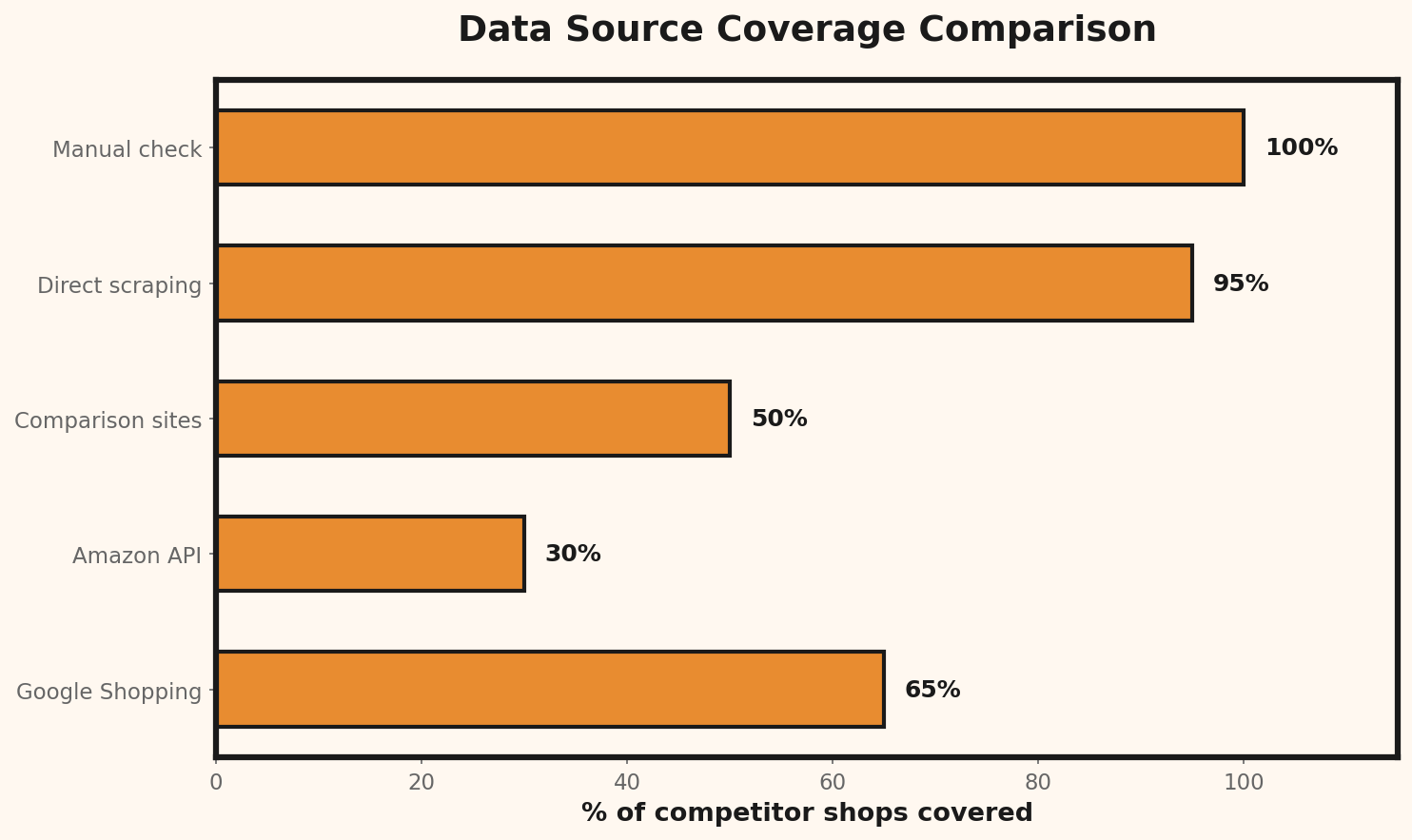
Not all data sources are equal. Here is how they compare on key criteria:| Data Source | Accuracy | Update Frequency | Coverage | Setup Effort | Cost |
|---|---|---|---|---|---|
| Google Shopping | High | Daily | Wide (multi-seller) | Low | Free |
| Marketplace APIs | Very High | Real-time | Platform-only | Medium | Free/Low |
| Price intelligence tools | High | Configurable | Customizable | Low | $50-$500/mo |
| Browser extensions | Medium | On-demand | Single-page | Very Low | Free |
| Manual checks | High | Manual | Limited | High (time) | Free |
| Custom scraping | High | Configurable | Unlimited | High (dev) | Variable |
How to Build an Ethical Monitoring System
Step 1: Be Transparent
Don't hide your activity. Use tools that identify themselves with a standard user-agent. Don't pretend to be a real browser if you're not.Step 2: Be Moderate
Don't check the same page every 5 minutes. Once a day is enough for most products. If you need higher frequency, use official APIs.Step 3: Respect robots.txt
If a website indicates in itsrobots.txt that it doesn't allow scraping, respect that. There are plenty of alternative sources.
Step 4: Public Data Only
Never attempt to access wholesale prices, subscription-only pricing, or any data that requires a login.Step 5: Document Your Method
If someone ever questions your practices, being able to demonstrate that you only accessed public data in a moderate and respectful manner is your best defense. For example, if you find that the average competitor price for a product is $45 and you're selling it at $52, you can assess your position like this:Your price: $52.00
Average competitor price: $45.00
Difference: +$7.00 (+15.6%)
Product cost: $28.00
Current margin: $24.00 (46.2% of selling price)
Margin if you match: $17.00 (37.8% of selling price)
Conclusion: Dropping to $45 would reduce your margin by 8.4 percentage points.Time and Cost Savings: Automated vs. Manual Monitoring
How much can you save by automating? Here is a quick estimate for monitoring 20 competitors across 50 products:Manual Monitoring (20 competitors x 50 products):
Time per check: 2 min per competitor-product pair
Total checks per day: 1,000
Time per day: 33.3 hours
Monthly cost (at $25/hr): $24,975
Automated Monitoring (e.g., Undercut):
Setup time: 2 hours (one-time)
Monthly subscription: $25/mo
Daily maintenance: 5 min
Monthly cost: $25 + ~$62.50 labor = $87.50
Monthly savings: $24,887.50
ROI: 28,400%
