
|5 min read|Verena Merklinghaus
5 E-Commerce Pricing Mistakes That Silently Kill Your Margins
ecommerce pricing mistakesprofit margin optimizationpricing errors online shopecommerce profit marginspricing strategy mistakesonline store profitability

Source: Unsplash
| Mistake | Frequency | Avg. Margin Impact |
|---|---|---|
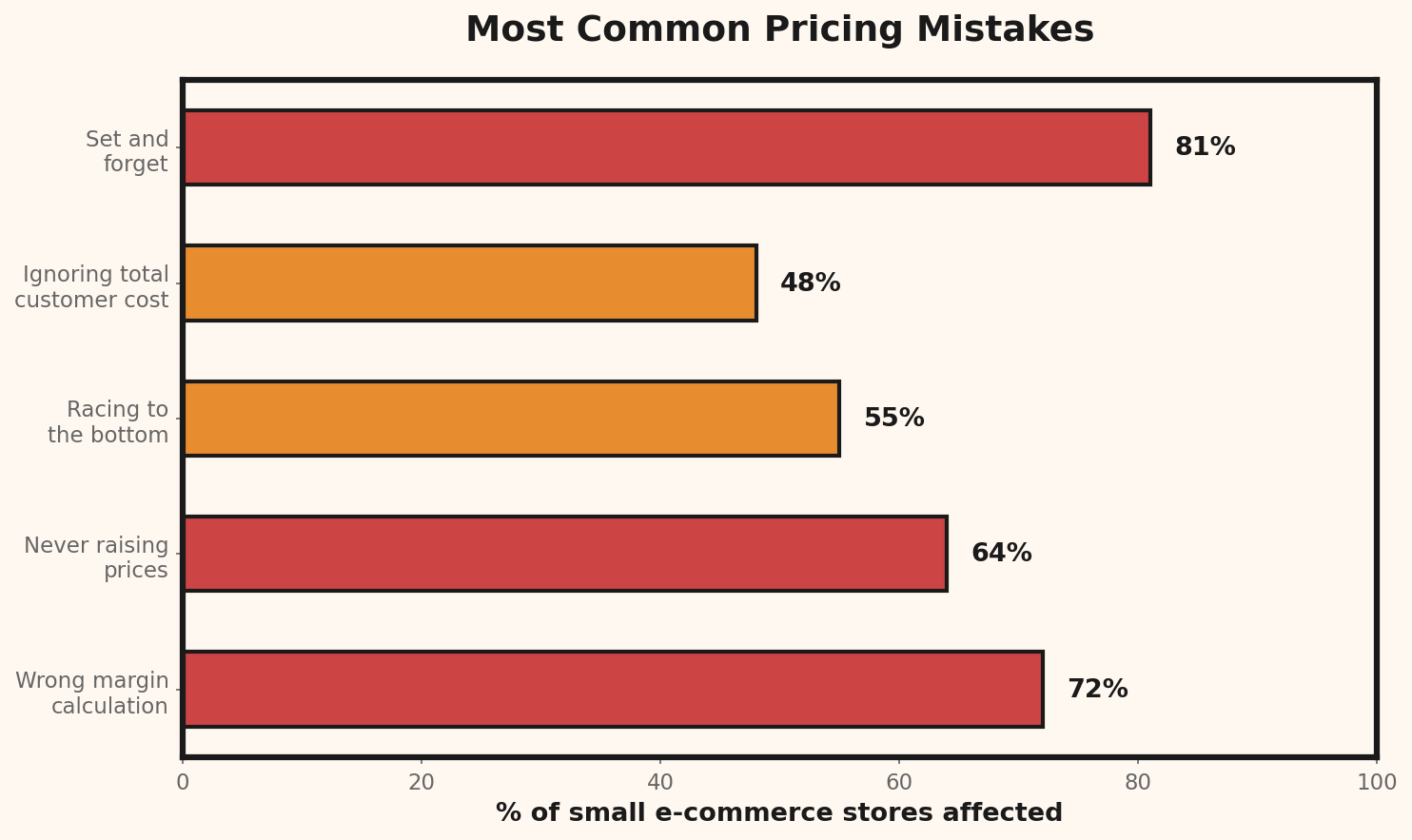
| Wrong margin calculation | 72% of sellers | -8% to -15% |
| Never raising prices | 65% of sellers | -5% to -10% |
| Racing to the bottom | 48% of sellers | -10% to -20% |
| Ignoring total customer cost | 58% of sellers | -3% to -7% |
| Set-and-forget pricing | 81% of sellers | -8% to -12% |

Source: Unsplash
Mistake 1: Calculating Margins on Revenue Instead of Profit
This is the most expensive mistake because it's invisible. What most sellers do:Product cost: $20
Selling price: $40
"My margin is 50%!"Product cost: $20.00
Shopify fees (2.9%): $1.16
Shipping materials: $1.50
Return rate (8%): $1.60
Marketing cost/unit: $4.00
True cost: $28.26
True margin: 29.4% (not 50%)Mistake 2: Never Raising Prices
Fear of losing customers keeps most sellers from ever raising prices. But there are clear signals that you're leaving money on the table:- Conversion rate above 4%. Industry average for e-commerce is 2-3%. If you're significantly above, you're probably too cheap.
- Frequent stockouts. Demand exceeds supply — classic signal to raise prices.
- Competitors priced 20%+ above you. If they're surviving, you're undervaluing yourself.

Source: Unsplash
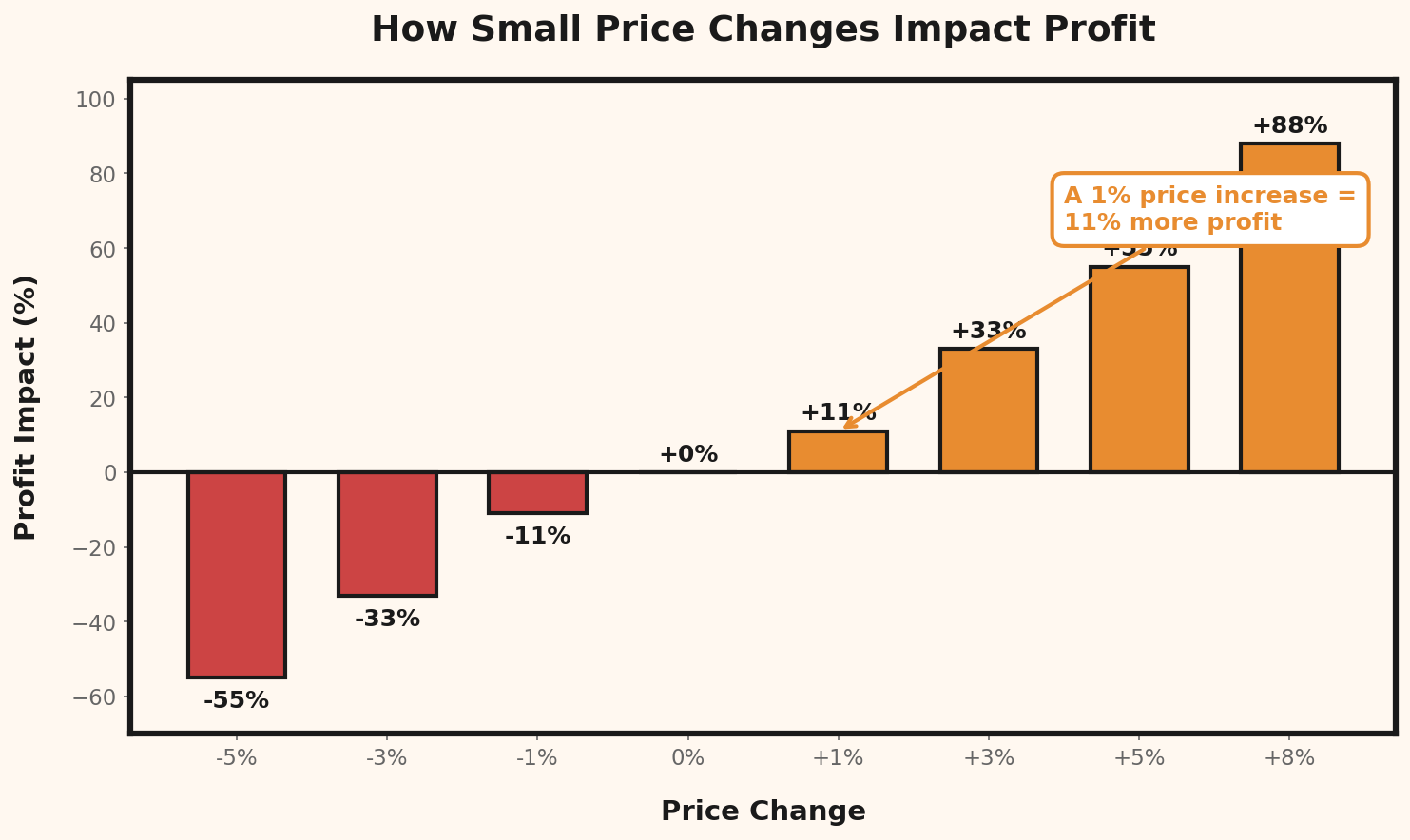
Example: 5% price increase impact
Current price:         $40.00
Current daily sales:   20 units
Daily revenue:         $800.00
True margin (29%):     $232.00

New price (+5%):       $42.00
Sales drop (-3%):      19.4 units
Daily revenue:         $814.80
True margin (32%):     $260.74

Daily profit increase: +$28.74 (+12.4%)Mistake 3: Racing to the Bottom on Price
When a competitor drops their price, the instinct is to match them. This creates a destructive spiral:- Is this a permanent change or a temporary promotion?
- Can this competitor sustain this price? (Check their shipping times, review quality, return policy)
- Is price the real reason customers choose them?
Mistake 4: Ignoring the Total Customer Cost
Your price tag isn't what the customer pays. The total cost includes:Product price: $35.00
Shipping: $5.99
Tax: $3.28
Total: $44.27Product price: $39.00
Shipping: $0.00
Tax: $3.12
Total: $42.12Mistake 5: Setting Prices Once and Forgetting
The market changes constantly. New competitors enter, costs fluctuate, seasonal demand shifts. But most online store owners set prices at launch and never touch them again. A real scenario: You set a price in January. By March, your supplier raised costs by 5%, shipping costs increased, and two new competitors entered your market at lower price points. Your margin has silently eroded by 8-12%, but you haven't noticed because you never check. The fix:- Monthly: Review margins on your top 20 products
- Quarterly: Check competitor prices across your full catalog
- Annually: Reassess your entire pricing strategy
The Cost of Delayed Price Reactions
How much does waiting cost you? Here's the math on delayed price adjustments:Scenario: Supplier raises costs 5%, you wait 3 months to adjust
Monthly revenue: $24,000
Original margin (29%): $6,960
New true margin after cost increase: 24.1%
Reduced monthly profit: $5,784
Monthly loss from delay: $1,176
Total loss over 3 months: $3,528
Annual projected loss: $14,112| Action Timeline | Monthly Profit | Cumulative Loss |
|---|---|---|
| Immediate adjustment | $6,960 | $0 |
| 1-month delay | $5,784 | $1,176 |
| 3-month delay | $5,784 | $3,528 |
| 6-month delay | $5,784 | $7,056 |
| Never adjusted | $5,784 | $14,112/year |

